
Zeolite vs. Activated Alumina vs. Silica Gel for Compressed Air Dryers
Zeolite vs. Activated Alumina vs. Silica Gel
A practical desiccant comparison for compressed air dryers and industrial air systems.
When moisture causes problems in a compressed air system, the desiccant inside the dryer matters more than most people realize. Zeolite molecular sieve, activated alumina, and silica gel all remove moisture, but they do not perform the same way.
Some are better for very low dew points. Some are better for dependable everyday industrial service. Some are more economical for lighter-duty applications. This guide breaks down the differences so it's easier to compare them side by side.
Desiccant Comparison Chart
| Category | Zeolite / Molecular Sieve | Activated Alumina | Silica Gel |
|---|---|---|---|
| Primary Strength | Very low dew point drying and selective adsorption | Reliable all-around industrial moisture removal | Economical moisture adsorption for lighter-duty use |
| Typical Dew Point Performance | Best option for very low dew points | Good for standard desiccant dryer performance | Less effective at very low humidity levels |
| Common Grades | 3A, 4A, 5A, 13X | Usually sold by size and application | Usually sold by bead type and size |
| How It Works | Uniform pore structure adsorbs molecules by size | Porous aluminum oxide adsorbs water vapor | Porous silica surface adsorbs moisture |
| Best For | Critical drying, instrument air, specialty gas drying, very low dew points | Compressed air dryers, general industrial air systems, dependable everyday service | Packaging, storage, and lower-demand drying applications |
| Moisture Affinity at Low Humidity | Excellent | Good | Fair |
| Typical Forms | Beads, pellets, powder | Beads and spheres | Beads and granules |
| Common Size Options | 1/16", 1/8", pellets, mesh sizes | 1/8", 3/16", 1/4" beads | Various bead and granular sizes |
| Equivalent Positioning | Premium desiccant for precision drying | Industrial standard for general dryer service | Economy option for less demanding use |
| Compressed Air Use | Excellent for very dry air requirements | Very common and proven choice | Less common in demanding dryer service |
| General Cost Position | Highest | Moderate | Lower |
What Is Zeolite Desiccant?
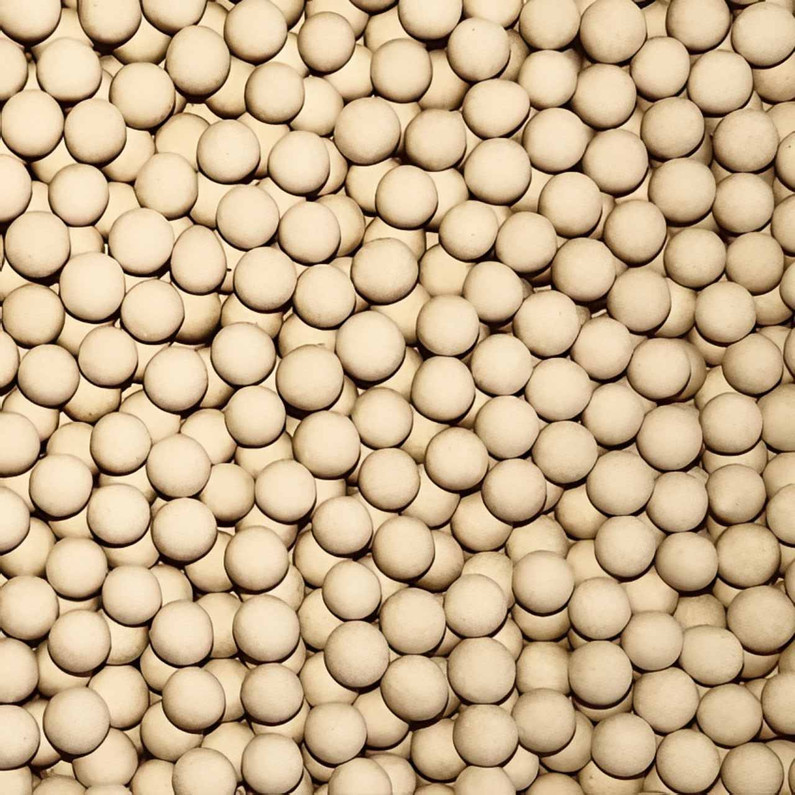
Zeolite desiccant is commonly sold as molecular sieve. What makes it different is its highly uniform pore structure, which allows it to selectively adsorb molecules by size. That is why molecular sieves are often used when the application calls for more precise drying performance.
In compressed air and gas drying, molecular sieve is typically considered the premium option when very low dew points are required. It is especially useful when ordinary drying media are not enough.
Common Molecular Sieve Grades
Used mainly for water adsorption while excluding larger molecules.
A common general-purpose choice for drying air and gas streams.
Suitable for adsorption of slightly larger molecules in specialized applications.
Higher-capacity option often used for more demanding drying and separation duties.
Typical Desiccant Sizes
Zeolite molecular sieve is commonly available in:
- 1/16" beads
- 1/8" beads
- Pellets
- Mesh or powdered forms for specialty applications
Activated alumina is often sold in common bead sizes such as 1/8", 3/16", and 1/4". Silica gel is also available in multiple bead and granular sizes depending on the application.
What Is Zeolite Equivalent To?
In practical terms, molecular sieve is usually positioned as a higher-performance desiccant compared to activated alumina and silica gel. It is not always a direct one-for-one substitute, but it is often chosen when the drying requirement is more demanding.
- Silica gel is typically the lower-cost option for lighter-duty moisture control.
- Activated alumina is the dependable industrial standard for many compressed air dryer applications.
- Zeolite molecular sieve is the premium upgrade for very low dew points and more selective adsorption.
Which Desiccant Should You Choose?
If the goal is the driest possible compressed air, molecular sieve is usually the best fit. If you want a durable and widely used desiccant for industrial service, activated alumina is often the most practical choice. If the application is less demanding and budget matters most, silica gel can still be a good option.
Need help choosing the right desiccant?
CompressorShop can help you compare molecular sieve, activated alumina, and silica gel for compressed air dryers, air treatment systems, and replacement desiccant applications.
Recent Posts
-
Zeolite vs. Activated Alumina vs. Silica Gel for Compressed Air Dryers
Zeolite vs. Activated Alumina vs. Silica Gel A practical desiccant comparison for compressed air d …Mar 27, 2026 -
The Resurgence of Natural Gas Deliquescent Dryers and Desiccants in 2025
How emission-free deliquescent desiccant technology is paving the way for greener operations and low …Jan 06, 2025 -
The Origins and Evolution of Compressed Air Technology
Compressed air, often referred to as the "fourth utility" alongside water, electricity, and natural …Jun 28, 2024