
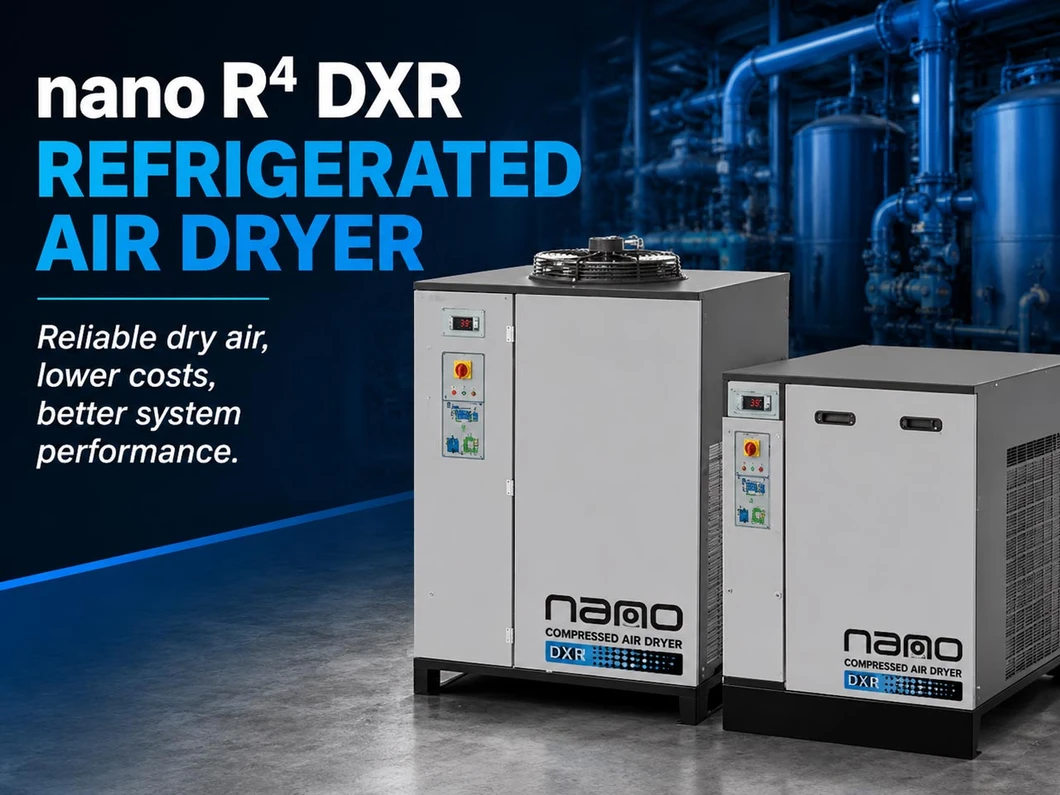
nano R4 DXR Refrigerated Air Dryers: Reliable Moisture Removal for Compressed Air
nano R4 Direct Expansion Refrigerated Air Dryers: Reliable Moisture Removal for Industrial Compressed Air
Moisture is one of the most common problems in a compressed air system. Every air compressor draws in atmospheric air containing water vapor, dust, hydrocarbons, and other contaminants. As the air is compressed and cooled, water vapor can condense into liquid water within the piping system.
Without proper air treatment, condensate can cause corrosion, frozen air lines, damaged pneumatic equipment, increased maintenance, production downtime, and product contamination. The nano R4 DXR direct expansion refrigerated air dryer provides a practical and energy-efficient way to remove this moisture before it reaches downstream equipment.
Why Compressed Air Needs to Be Dried
Compressed air filters are essential for removing solid particles, liquid water, and oil aerosols. However, a standard compressed air filter cannot remove moisture that remains in vapor form.
As compressed air moves through the system and its temperature changes, that water vapor can condense into liquid. The resulting moisture may lead to:
- Corrosion inside compressed air piping
- Premature failure of pneumatic valves and cylinders
- Frozen outdoor air lines during cold weather
- Contaminated tools, equipment, and finished products
- Increased maintenance and unplanned downtime
- Reduced efficiency throughout the compressed air system
A refrigerated air dryer lowers the temperature of the compressed air so moisture condenses in a controlled location, where it can be separated and discharged before the air enters the plant piping.
How the nano R4 DXR Refrigerated Air Dryer Works
The nano R4 DXR uses a direct expansion refrigeration circuit and an integrated heat exchanger to cool the compressed air, remove condensed moisture, and reheat the dry air before it leaves the dryer.
- Pre-cooling: Hot, moisture-laden compressed air enters the air-to-air section of the heat exchanger. The incoming air is pre-cooled by the colder dry air leaving the dryer.
- Refrigeration: The pre-cooled air passes through the air-to-refrigerant evaporator, where it reaches its lowest temperature and water vapor condenses into liquid.
- Moisture separation: An integrated separator removes the condensed water from the compressed air.
- Condensate discharge: A zero air loss drain automatically expels the collected water without unnecessarily releasing compressed air.
- Reheating: The cold, dry air returns through the air-to-air heat exchanger, where it is reheated by the incoming compressed air. This helps prevent sweating on downstream piping.
The refrigeration circuit uses a compressor, air-cooled condenser, refrigerant filter, capillary tube, and hot gas bypass valve to maintain dependable cooling performance.
Consistent Dew Point and Reliable Operation
The nano R4 DXR is designed for continuous-duty industrial operation. Its integrated aluminum block heat exchanger combines air-to-air cooling, air-to-refrigerant cooling, and moisture separation in one compact assembly.
This design helps the dryer provide:
- A stable pressure dew point
- Low and consistent pressure drop
- Efficient heat transfer
- Reliable moisture separation
- Compact installation dimensions
Depending on system requirements, the DXR series can help provide compressed air suitable for ISO Class 4, 5, or 6 moisture levels.
Energy-Efficient Aluminum Heat Exchanger
The fully insulated aluminum block heat exchanger is designed to maximize cooling efficiency. Incoming compressed air is pre-cooled by the outgoing dry air, reducing the refrigeration load and helping lower electrical consumption.
The integrated water separator also reduces the number of separate components required inside the dryer. This compact arrangement helps improve reliability while keeping the overall footprint manageable.
Zero Air Loss Condensate Drain
Every nano R4 DXR dryer includes an energy-efficient zero air loss drain. Unlike a basic timer drain that opens at preset intervals, the zero air loss drain removes condensate when necessary without continuously venting valuable compressed air.
This provides several practical benefits:
- Reduced compressed air waste
- Lower compressor operating costs
- Automatic condensate removal
- Less manual maintenance
- Improved overall system efficiency
Compressor Shop Tip: A leaking or improperly adjusted condensate drain can waste a surprising amount of compressed air. A properly maintained zero air loss drain helps remove water without creating a continuous artificial demand on the compressor.
Hot Gas Bypass for Stable Performance
Compressed air demand can vary throughout the day. During low-flow conditions, a refrigerated dryer may become too cold, creating the possibility of condensate freezing inside the heat exchanger.
The nano DXR uses a hot gas bypass valve to maintain an optimal evaporator temperature. This helps stabilize the pressure dew point while reducing the risk of freeze-up and ice formation inside the dryer.
User-Friendly Digital Controller
The digital controller gives operators a quick view of dryer performance and provides useful service and alarm functions.
Available controller features include:
- Outlet dew point display
- Automatic restart following a power interruption
- Service reminder alarm
- Alarm contacts on DXR 0050 N through DXR 4200 N models
- Remote start and stop capability on DXR 0325 N through DXR 4200 N models
These controls make it easier to monitor the dryer and integrate larger models into a facility control system.
Piston and Scroll Refrigeration Compressors
The DXR series uses refrigeration compressor technology selected for the capacity of each model.
- Models through 600 SCFM use durable piston compressors designed for dependable service and long operating life.
- Models rated at 850 SCFM and higher use quieter, energy-efficient scroll compressors with low maintenance requirements.
This allows the refrigeration system to be matched more closely to the operating range and expected duty of the dryer.
Compact and Easy to Install
The nano R4 DXR is supplied as a complete packaged dryer. Its plug-and-play design simplifies installation and helps reduce the amount of field assembly required.
Additional construction features include:
- Compact, space-saving cabinet
- Powder-coated galvanized steel panels
- Corrosion-resistant exterior construction
- Fully insulated heat exchanger
- Low-GWP R513A or R410A refrigerant, depending on model
Pre-filter and after-filter packages are also available to protect the dryer, improve downstream air quality, and help maintain efficient operation.
Available Capacities
The nano R4 DXR dryer range covers compressed air systems from small workshops to large industrial facilities. Rated capacities extend from 10 to 4,200 SCFM.
| Model Range | Rated Capacity Range | Connection Range |
| DXR 0010 N to DXR 0250 N | 10 to 250 SCFM | 1/2" to 1-1/2" NPT |
| DXR 0325 N to DXR 0600 N | 325 to 600 SCFM | 2" to 2-1/2" NPT |
| DXR 0850 N to DXR 1250 N | 850 to 1,250 SCFM | 3" NPT |
| DXR 1600 N to DXR 2400 N | 1,600 to 2,400 SCFM | 4" ANSI flange |
| DXR 3000 N to DXR 4200 N | 3,000 to 4,200 SCFM | 6" ANSI flange |
Common Applications
nano R4 DXR refrigerated air dryers are suitable for a wide range of general industrial compressed air applications, including:
- Manufacturing and assembly plants
- Automotive service and production facilities
- CNC machining operations
- Pneumatic tools and automation equipment
- Packaging systems
- Paint preparation and general spray applications
- Food and beverage support equipment
- Warehouses and maintenance shops
A refrigerated dryer is generally a good choice when the compressed air system needs a dependable pressure dew point but does not require the extremely low dew points provided by a desiccant air dryer.
How to Size a nano DXR Refrigerated Air Dryer
Dryer selection should be based on actual operating conditions rather than compressor horsepower alone. The most important sizing factors include:
- Maximum compressed air flow in SCFM
- Dryer inlet pressure
- Compressed air inlet temperature
- Maximum ambient temperature
- Required pressure dew point
- Expected future system expansion
The published DXR capacities are rated according to ISO 7183 conditions using 100 PSIG inlet pressure, 100°F inlet air, and 100°F ambient temperature. Dryer capacity changes when the actual inlet temperature, ambient temperature, or operating pressure differs from those rated conditions.
Higher inlet and ambient temperatures generally reduce available dryer capacity. Pressure and temperature correction factors should therefore be applied before selecting a model.
Compressor Shop Tip: Avoid sizing a refrigerated dryer only for the compressor's published displacement. Use the highest actual system airflow and worst expected summer conditions. A dryer that is marginally sized may struggle to maintain its dew point on hot, humid days.
Pre-Filtration and Maintenance
Proper pre-filtration helps protect the dryer heat exchanger and zero air loss drain from oil aerosols, scale, rust, and other contaminants. An after-filter may also be installed when the application requires additional particulate removal downstream of the dryer.
Routine maintenance should include:
- Inspecting and replacing compressed air filter elements as required
- Checking the condensate drain for proper operation
- Keeping the condenser coil clean and unobstructed
- Maintaining adequate ventilation around the dryer
- Monitoring the displayed dew point and service alarms
- Checking the refrigeration system for unusual noise or operating temperatures
A clean condenser and properly functioning drain are especially important. Restricted airflow through the condenser can raise refrigeration pressures, while a blocked drain can allow water to carry downstream into the compressed air system.
Why Choose a nano R4 DXR Refrigerated Air Dryer?
The nano R4 DXR combines straightforward refrigeration technology with features designed for reliable industrial use. Its aluminum heat exchanger, integrated moisture separator, digital controller, hot gas bypass valve, and zero air loss drain work together to provide consistent dry air with minimal compressed air waste.
With models ranging from 10 to 4,200 SCFM, the DXR series can support everything from a small shop compressor to a large plant air system. Properly sized and maintained, it can help protect downstream equipment, reduce maintenance costs, improve product quality, and keep the compressed air system operating efficiently.
Looking for the Right Refrigerated Air Dryer?
Browse our complete selection of nano R4 DXR refrigerated air dryers, or contact our compressed air specialists for sizing assistance.
Shop nano R4 DXR Dryers »Recent Posts
-

Walker Filtration Compressed Air Filter Housings Guide
Walker Filtration offers compressed air filter housings for everything from a small point-of-use air …Aug 25, 2026 -
nano R4 DXR Refrigerated Air Dryers: Reliable Moisture Removal for Compressed Air
nano R4 Direct Expansion Refrigerated Air Dryers: Reliable Moisture Removal for Industrial Compresse …Aug 07, 2026 -

Why Valves and Seals Matter in Compressed Air Systems
Valves and seals are some of the most overlooked components in a compressed air system, yet they di …May 30, 2026